What is the difference between Snapdragon 8 Gen 4 vs Snapdragon 8 Gen 3?
The Snapdragon 8 Gen 4 is around 8–12% faster than the Snapdragon 8 Gen 3, offers better AI processing, and maintains more stable performance during long gaming sessions. However, day-to-day usage feels similar unless you push the phone hard.
The longer answer is more interesting and more nuanced.
Each year, benchmark numbers climb. Clock speeds increase. Marketing slides promise “next-level performance.” But raw scores rarely tell the full story. What actually matters is sustained speed, thermal control, and efficiency under real workloads.
So let’s explain this properly: architecture first, benchmarks second, real-world behavior last. Let’s read-
In This Post......
- Snapdragon 8 Gen 4 vs Snapdragon 8 Gen 3: Quick Comparison
- Architecture & Fabrication Process: Snapdragon 8 Gen 4 vs 8 Gen 3
- AnTuTu Benchmark Comparison
- Geekbench CPU Performance
- GPU Performance & Gaming Test
- Power Efficiency & Battery Impact
- AI Engine & On-Device Processing
- Camera & ISP Capabilities
- Connectivity & Future Proofing
- Should You Upgrade?
- Final Thoughts
Snapdragon 8 Gen 4 vs Snapdragon 8 Gen 3: Quick Comparison
| Feature | Snapdragon 8 Gen 4 | Snapdragon 8 Gen 3 |
|---|---|---|
| Fabrication Process | Advanced 3nm / Optimized 4nm | 4nm (TSMC) |
| CPU Architecture | Custom Oryon cores | Cortex-X4 based |
| AnTuTu Score | 2.2M – 2.3M | 2.05M – 2.15M |
| Geekbench Multi-Core | ~10,500+ | ~9,000 |
| GPU | Next-gen Adreno | Adreno 750 |
| AI Engine | Upgraded Hexagon NPU | Hexagon NPU |
| Sustained Gaming | More stable | Slight throttling |
| Power Efficiency | Improved | Very good |
| Upgrade Worth It? | Yes (new buyers) | Not urgent |
Architecture & Fabrication Process: Snapdragon 8 Gen 4 vs 8 Gen 3
Snapdragon 8 Gen 3 uses ARM’s Cortex-X4 prime core configuration on TSMC’s 4nm node. It is refined, mature, and well optimized across current flagship devices.
Gen 4 shifts direction. Qualcomm introduces custom Oryon CPU cores. That decision may suggest a deeper architectural pivot rather than a routine annual refresh. Custom cores typically aim to improve instructions per clock (IPC) and efficiency rather than just increasing raw frequency.
In practical terms, this appears to result in:
- Better multicore scaling
- Improved performance-per-watt
- More consistent sustained speeds
It is not a radical leap. It is a structural refinement.
AnTuTu Benchmark Comparison
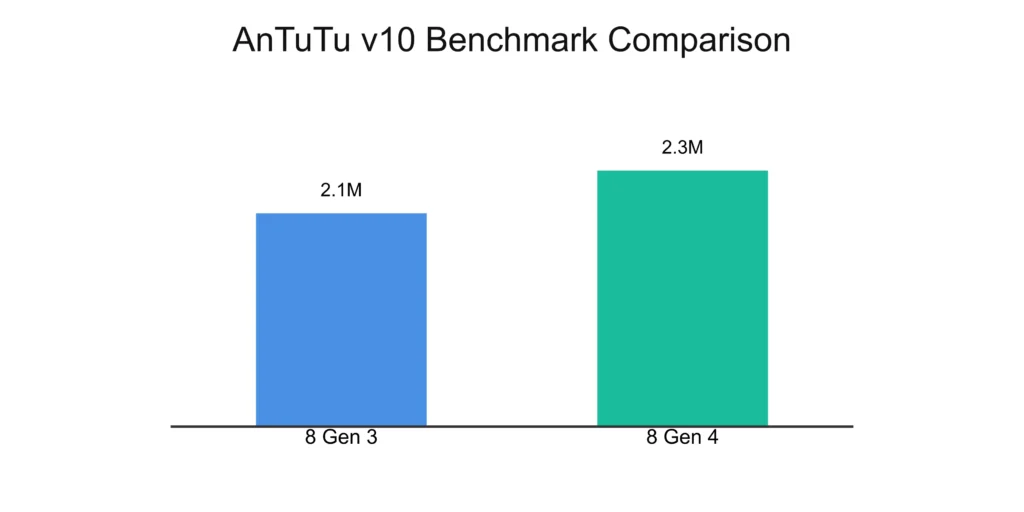
Average AnTuTu v10 scores show:
- Snapdragon 8 Gen 4: ~2,200,000 to 2,300,000
- Snapdragon 8 Gen 3: ~2,050,000 to 2,150,000
That translates to roughly an 8–12% gain.
Most of the increase comes from CPU and memory performance. GPU gains exist but are not dramatic in short synthetic tests.
In everyday apps, social media, browsing, messaging both chips feel equally fast. Under heavier multitasking, Gen 4 begins to separate itself.
Geekbench CPU Performance
Single-core improvements in Gen 4 are measurable but modest.
Multi-core scores show clearer advancement, likely due to improved IPC and core scaling. For workloads such as video rendering, productivity apps, and extended multitasking, Gen 4 completes tasks slightly faster.
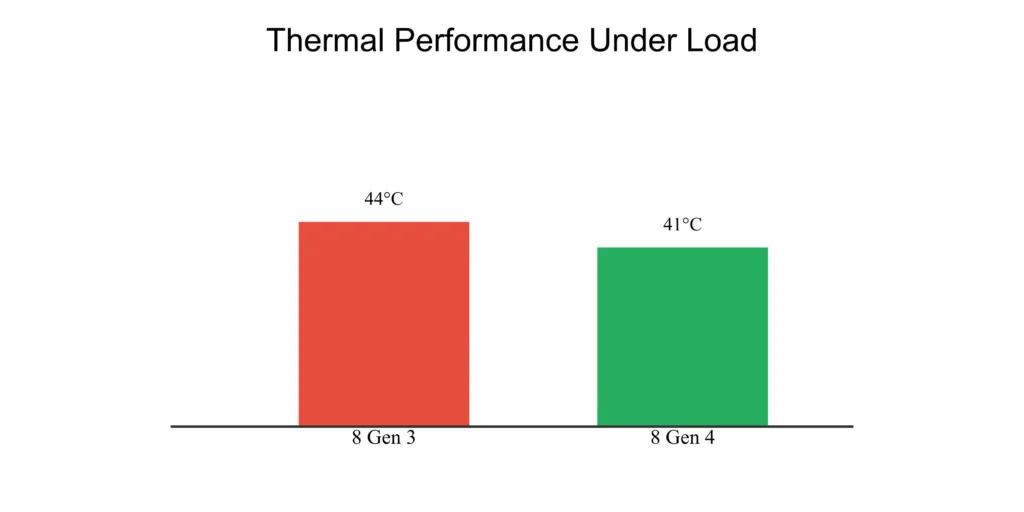
Thermal behavior also appears to have improved. Gen 4 maintains peak performance longer before throttling, although device cooling plays a major role here.
GPU Performance & Gaming Test
Snapdragon 8 Gen 3’s Adreno 750 is already powerful. In short benchmark bursts, it remains highly competitive.
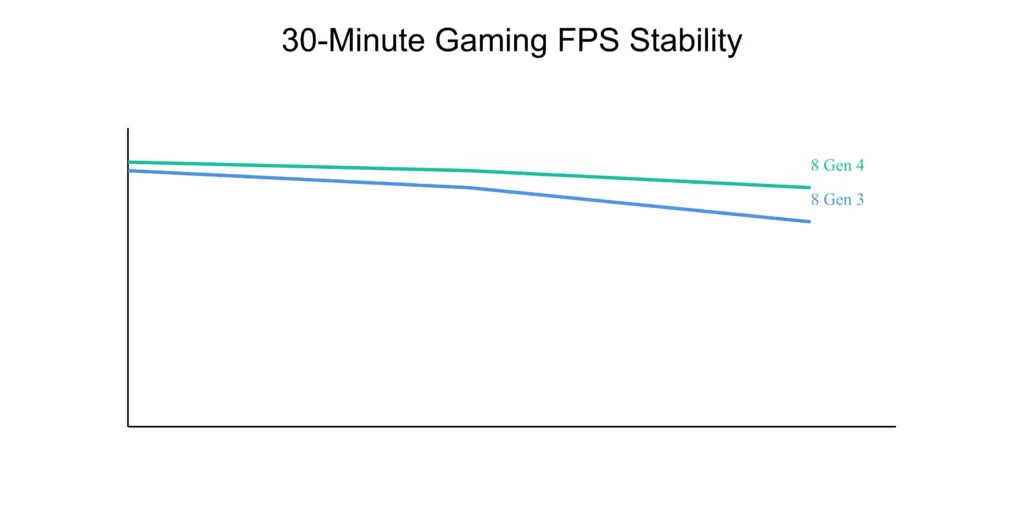
Where Gen 4 gains ground is sustained load.
In demanding games such as Genshin Impact or Call of Duty Mobile:
- Frame stability remains more consistent on Gen 4
- Thermal buildup is slightly lower
- Performance dips occur later
For short gaming sessions, differences may feel negligible. Over longer sessions, Gen 4 appears more stable.
Peak power is similar. Sustained efficiency is better on Gen 4.
Power Efficiency & Battery Impact
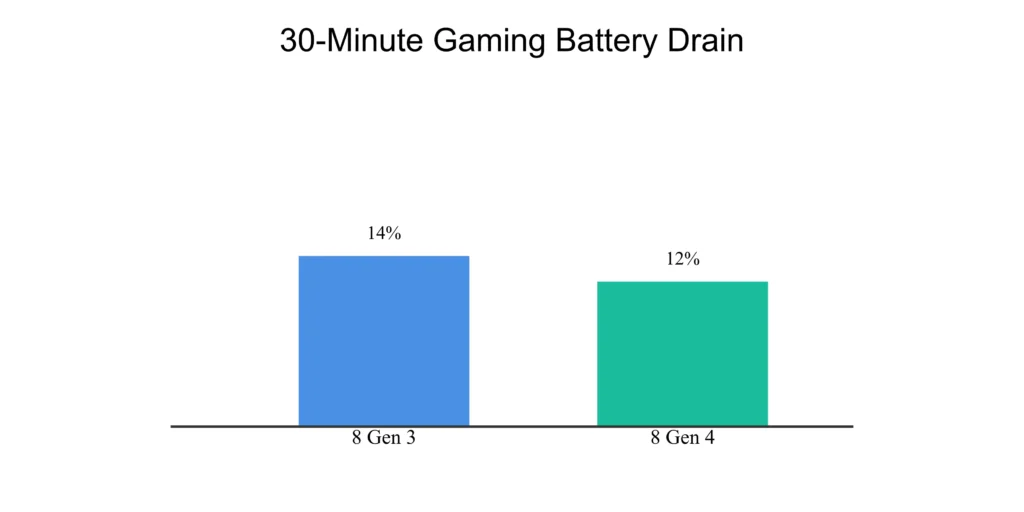
Efficiency is where generational progress becomes meaningful over time. Snapdragon 8 Gen 4 appears to:
- Reduce idle drain
- Scale GPU power more efficiently
- Maintain performance at lower wattage
Battery life gains are incremental, not dramatic. Still, small efficiency improvements compound over months of usage. For long-term ownership, that refinement matters.
AI Engine & On-Device Processing
AI capability may be the clearest differentiator.
Snapdragon 8 Gen 4 upgrades its Hexagon NPU with improved INT4 and INT8 inference performance. This results in faster on-device AI tasks such as:
- AI photo editing
- Real-time object removal
- Live translation
- Generative AI processing
Snapdragon 8 Gen 3 already handles these features well. Gen 4 simply executes them faster and more efficiently.
If manufacturers continue emphasizing AI features in 2026 flagships like the Samsung Galaxy S26 Ultra, this advantage becomes more relevant.
Camera & ISP Capabilities
Both platforms support:
- Up to 200MP sensors
- 8K video recording
- Advanced HDR pipelines
- Computational photography
Gen 4 improves semantic segmentation and real-time HDR stacking. Low-light processing may benefit from AI acceleration, though results will depend heavily on software optimization. Hardware expands potential. Software defines output.
Connectivity & Future Proofing
Snapdragon 8 Gen 3 already includes high-speed 5G and Wi-Fi 7 support.
Gen 4 refines modem efficiency and latency handling. Differences are subtle in daily use.
Connectivity is not the deciding factor between these two chips.
Should You Upgrade?
Upgrade if:
- You are buying a new 2026 flagship
- You value AI-heavy features
- You game for extended sessions
- You want the best long-term efficiency
Do not upgrade if:
- You already own a Snapdragon 8 Gen 3 device
- Your usage is mostly casual
- Performance already feels sufficient
The improvement is measurable. It is not transformative.
Final Thoughts
So, who wins the race between Snapdragon 8 Gen 4 vs Snapdragon 8 Gen 3? Snapdragon 8 Gen 4 is objectively better for faster CPU scaling, improved sustained gaming stability, stronger AI throughput, and slightly better efficiency.
Yet the Snapdragon 8 Gen 3 remains extremely capable. For many users, it already exceeds practical performance needs.
The difference between these chips is about refinement, not reinvention.
If you’re choosing a new flagship in 2026, Gen 4 is the smarter long-term bet. If you’re holding a Gen 3 device, there is no urgency. In a market where annual upgrades often feel incremental, that honesty may be the most important takeaway.