Shopping for a new flagship in 2026 can feel like standing in front of two equally tempting doors. Behind one is Apple’s polished, tightly controlled ecosystem. Behind the other is Android’s sprawling buffet of choice, customisation, and raw hardware ambition. Both doors lead somewhere genuinely good, and that’s exactly what makes the decision hard.
This isn’t going to be another “Apple is obviously better” or “Android wins every time” piece. Those arguments are mostly noise. Instead, we’re going to walk through the categories that actually shape your day-to-day experience: performance, cameras, AI features, battery life, software longevity, and price and look honestly at where each platform pulls ahead. By the end, you’ll know exactly which side of the best flagship phones 2026: Apple vs Android debate fits the way you actually use your phone and where to find the best deal once you’ve decided.
In This Post......
- Why This Comparison Matters More in 2026
- Performance and Everyday Speed
- Camera Systems: Where the Real Differences Show Up
- AI Features: Two Very Different Philosophies
- Battery Life and Charging Speed
- Software Updates and Long-Term Value
- Customization and Ecosystem Integration
- Price and Value Across the Range
- Quick Decision Framework
- Final Thought
Why This Comparison Matters More in 2026
Every year the gap between iPhone and Android flagships narrows in some places and widens in others. In 2026, the two ecosystems have leaned harder into their own philosophies rather than copying each other.
Apple has doubled down on on-device AI, video quality, and longevity. Android flagships, particularly Samsung’s Galaxy S series and Google’s Pixel line, have pushed zoom photography, charging speed, and customization to new extremes.
That divergence is good news for buyers. It means the “best flagship phone” question doesn’t have one universal answer anymore. It has an answer that depends on you: your existing devices, your budget, what you photograph, and how long you plan to keep the phone before upgrading. Let’s break it down category by category.
Performance and Everyday Speed
Both platforms are fast enough in 2026 that “which one is faster” is almost the wrong question. The better question is which one feels consistently fast.
Apple’s latest silicon continues to lead in single-core performance and power efficiency, and because Apple controls both the chip and the software running on it, that performance stays smooth for years rather than just on day one. This is the iPhone’s quiet superpower; it doesn’t always win benchmarks by a huge margin, but it rarely feels sluggish, even three or four years into ownership.
Android flagships, particularly those running Qualcomm’s latest Snapdragon chips, are extremely close in raw power and often pull ahead in multi-core and GPU-heavy tasks like gaming.
The catch is that “Android performance” isn’t one number; it’s a spectrum. A Galaxy S-series flagship or a Pixel Pro will feel every bit as smooth as an iPhone. A cheaper Android phone running the same OS version can feel noticeably less refined.
The takeaway: if you want guaranteed consistency regardless of price tier, the iPhone has the edge. If you’re buying a true Android flagship rather than a budget model, the performance gap essentially disappears.
Camera Systems: Where the Real Differences Show Up
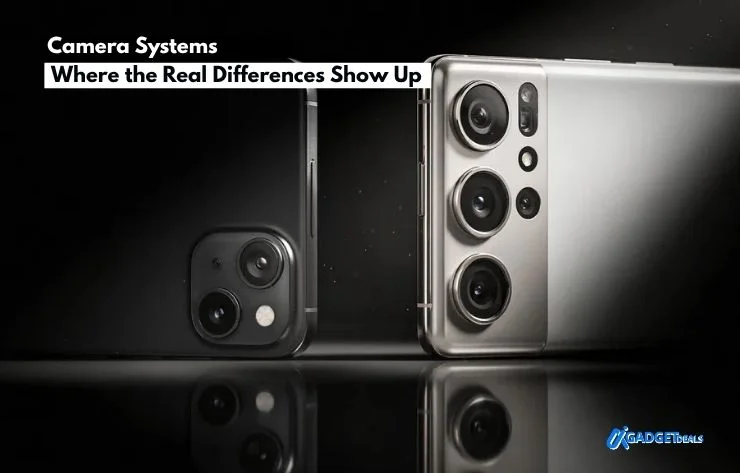
This is where the best flagship phones of 2026: Apple vs Android comparison gets genuinely interesting, because neither side wins outright; they win at different things.
iPhone’s strength is video. Cinematic Mode, log-format capture, and high-frame-rate 4K recording remain unmatched by anything on Android. Colour science is also more natural and consistent across lighting conditions, which is why so many content creators still shoot on iPhone even when they edit and post from elsewhere.
Android’s strength is zoom and computational tricks. Samsung’s Ultra-tier flagships push optical zoom ranges that no iPhone can touch, which matters enormously if you photograph wildlife, concerts, or anything far away. Google’s Pixel flagships lead in low-light photography and AI-powered editing, tools like intelligent object removal and “best version of this group photo” features are more refined on Pixel than anywhere else.
If you mostly shoot quick photos and the occasional video for social media, either platform will serve you well. If video is central to what you do, the iPhone is the safer bet. If zoom or computational night photography matters more, an Android flagship, specifically Samsung or Pixel, pulls ahead.
AI Features: Two Very Different Philosophies
AI is no longer a bonus feature in 2026; it’s baked into how both platforms operate, but the approaches couldn’t be more different.
Apple’s on-device AI approach processes most requests locally on the phone rather than sending them to a server. That means faster responses for many tasks and a privacy advantage that matters to a lot of buyers. Writing tools, photo cleanup, and smarter notification summaries are now woven into nearly every native app.
Android’s AI story, led by Google’s Gemini-powered tools and Samsung’s own AI suite, leans into breadth and speed of iteration.
Real-time translation, Circle to Search, and advanced photo editing tools tend to arrive on Android first and in more experimental forms. The trade-off is that more of this processing happens off-device, which means a heavier reliance on a strong internet connection and a few more questions around data handling.
Neither approach is objectively better, it’s privacy-first-and-steady versus feature-rich-and-fast-moving. Your answer here probably already tells you which platform fits your instincts.
Battery Life and Charging Speed
If charging speed is a priority, Android wins this category without much argument. Many Android flagships now charge from empty to full in well under 30 minutes, with wired charging speeds that dwarf what iPhone offers. Battery capacities also tend to run larger on Android flagships.
iPhone counters with battery longevity rather than raw charging speed. Apple’s power efficiency and battery health management mean the battery degrades more slowly over years of daily use, even if a single charge takes longer to top up.
Simple framing: Android if you want to go from low battery to full in a coffee break. iPhone if you care more about how the battery performs in year three than how fast it charges today.
Software Updates and Long-Term Value
This category has quietly become one of the most important, and most overlooked, parts of any flagship purchase. A phone you’ll use for four or five years needs an OS that keeps up for that long.
Apple guarantees major iOS updates for around six years after release, delivered to every supported device on the same day regardless of carrier. It’s predictable, and that predictability is worth something.
Android’s update story used to be its biggest weakness, but the top tier has closed the gap. Google’s own Pixel devices and Samsung’s flagship Galaxy S series now offer seven years of OS and security updates, technically longer than Apple’s commitment. The catch is that this only applies to the true flagships. Budget and mid-range Android phones can still fall off support within two to three years, which matters if you’re comparing a genuine flagship-to-flagship purchase.
Bottom line: if you’re buying an actual flagship, iPhone, Pixel Pro, or Galaxy S Ultra, long-term software support is no longer a meaningful differentiator. It only becomes one if you drift toward cheaper Android hardware.
Customization and Ecosystem Integration
Android wins customization clearly and without much debate. You can swap launchers, set any app as default, build a home screen full of interactive widgets, and access the file system directly. If you like shaping your phone around your habits rather than adapting to someone else’s vision of how a phone should work, Android remains the more flexible platform.
iPhone’s counter-argument is ecosystem integration. If you already own a Mac, iPad, or Apple Watch, the way these devices talk to each other, Handoff, AirDrop, Universal Clipboard, using your iPhone as a webcam, creates a level of seamlessness that Android’s more fragmented cross-device story still can’t fully match, even with Google’s improvements in this area.
This one really does come down to what’s already in your pocket and on your desk. Heavily invested in Apple hardware already? iPhone. Platform-agnostic, or running Windows and Android side by side? Android’s flexibility will feel more natural.
Price and Value Across the Range
Android dominates on raw price range and entry-level value. You can get a genuinely capable Android flagship-adjacent phone for a few hundred dollars less than the cheapest current iPhone, and the mid-range Android market in 2026 is stronger than it’s ever been.
iPhone counters with resale value. iPhones consistently retain a noticeably higher percentage of their original price after two years compared to Android flagships. If you’re someone who upgrades every couple of years and sells or trades in the old phone, that resale gap can meaningfully offset the higher upfront cost.
This is exactly the kind of decision where comparing live prices before you buy makes a real difference, and it’s a big part of why we built AIGadgetDeals in the first place.
Whichever side of the best flagship phones 2026: Apple vs Android debate you land on, you can compare current deals on the latest iPhone and Android flagships on our site before committing to one.
Quick Decision Framework
- Choose an iPhone if: you already own other Apple devices, want the best video camera available, care about long-term battery health and predictable updates, or prefer privacy-first AI processing.
- Choose an Android flagship if: you want the fastest charging speeds, the longest optical zoom, deep customization, or simply more choice across price points.
- Choose Pixel specifically if: computational photography and AI editing tools matter more to you than raw zoom range.
- Choose Samsung Galaxy S Ultra specifically if: you want the single most versatile camera hardware on the Android side, paired with a stylus and a large display.
Final Thought
There’s no universal winner in the best flagship phones 2026: Apple vs Android conversation, and there probably never will be. iPhone remains the strongest choice for video quality, ecosystem integration, and predictable long-term performance. Android, specifically a true flagship from Samsung or Google leads on charging speed, zoom photography, and customization, while finally closing the update-longevity gap that used to be its weak point.
The smartest move isn’t picking a side based on brand loyalty. It’s matching the platform to how you actually use your phone and then making sure you’re not overpaying for it. Before you check out, take a minute to compare current prices on this year’s top iPhone and Android flagships on AIGadgetDeals. The right phone at the wrong price is still the wrong purchase.