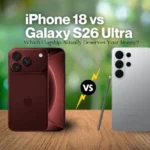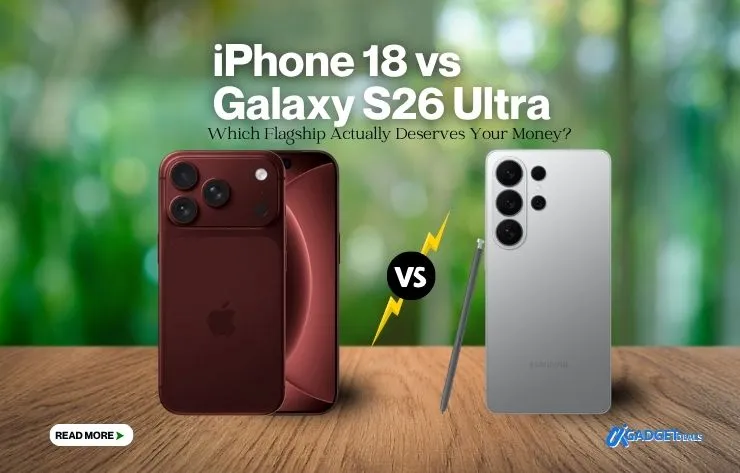
So you’re stuck between two of the biggest phones of the year. Welcome to the club; it’s a crowded one. Every fall and every spring, the same question pops up in our group chats, comment sections, and inboxes here at AIGadgetDeals: iPhone 18 or Galaxy S26 Ultra? And honestly, it’s a fair question, because this year the gap between the two camps is narrower than it’s been in a while.
We’ve spent time digging through the specs, the rumors, the early hands-on impressions, and the real-world feedback to put together this iPhone 18 vs Galaxy S26 Ultra breakdown. No fluff, no fanboy bias, just what actually matters when you’re about to drop over a thousand dollars on a phone you’ll be staring at every single day for the next two to three years.
Let’s get into it.
In This Post......
- The Quick Verdict (For the Impatient)
- Design and Build: Familiar Faces, Small Refinements
- Display: Both Excellent, Different Philosophies
- Performance: Apple’s Silicon Advantage
- Camera Showdown: Sensors vs. Software
- Battery Life and Charging
- Software and Ecosystem: The Real Deciding Factor
- Price: What You’re Actually Paying For
- So, Which One Should You Actually Buy?
- Final Thoughts
The Quick Verdict (For the Impatient)
If you want the short version before we dive deep: the iPhone 18 wins on raw performance, efficiency, and long-term software support. The Galaxy S26 Ultra wins on camera versatility, charging speed, and sheer feature density thanks to the S Pen and Galaxy AI. Neither one is a bad choice, but they’re built for genuinely different kinds of users, and that’s really what this comparison comes down to.
Now let’s break down exactly why.
Design and Build: Familiar Faces, Small Refinements
Neither company is reinventing the wheel this year, and that’s not necessarily a bad thing.
The iPhone 18 sticks close to the formula Apple has been refining for the last few generations: an aluminum frame, a glass back, and (on the Pro models) that now-familiar camera plateau stretching across the rear. The Dynamic Island gets a bit narrower this time around, which is a small but welcome change if you’ve ever felt like it ate into your screen real estate.
The Galaxy S26 Ultra, on the other hand, continues with Samsung’s flat-edge design language but swaps titanium for aluminum on the frame. It’s a move that should make the phone feel a touch lighter in hand, and early specs suggest it actually is coming in noticeably lighter than its Apple counterpart. The S Pen is still tucked into the chassis, which remains one of the Galaxy’s Ultra line’s biggest differentiators. If you’ve ever wanted a stylus built directly into your phone instead of carrying a separate one, that’s a box only Samsung checks here.
Bottom line: if subtle refinement and brand familiarity matter to you, the iPhone 18 plays it safe. If you want a phone that still surprises you with built-in tools, the Galaxy S26 Ultra has the edge.
Display: Both Excellent, Different Philosophies
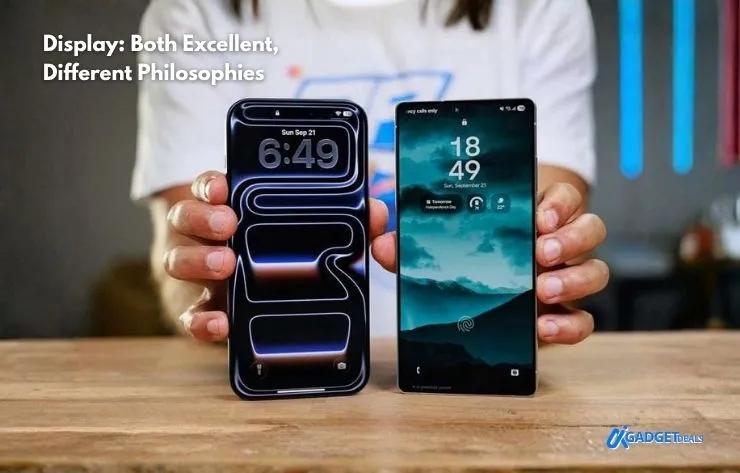
Both phones land around the 6.9-inch mark, and both are genuinely gorgeous in person; this isn’t a category where you’ll feel shortchanged either way.
Apple’s panel benefits from ProMotion’s adaptive refresh rate and class-leading color accuracy, paired with seriously high peak brightness for outdoor visibility. Samsung counters with its Dynamic AMOLED panel and a clever trick: a Privacy Display mode that narrows the viewing angle on demand, so the person next to you on the train can’t casually read your messages.
It’s a small feature, but if you’ve ever worked in public spaces or commute often, it’s the kind of thing you don’t know you want until you have it.
Performance: Apple’s Silicon Advantage
This is where the iPhone 18 starts to really pull ahead, at least on paper.
Apple’s chip is built on a smaller manufacturing process than Samsung’s Snapdragon silicon, which generally translates to better efficiency and, often, better sustained performance under heavy workloads. If you’re someone who edits 4K video on your phone, plays graphically demanding mobile games, or just wants headroom that lasts for years, this matters.
That’s not to say the Galaxy S26 Ultra is slow — far from it. The Snapdragon chip powering it is one of the best Android has to offer, and for the vast majority of everyday tasks (scrolling, messaging, browsing, even multitasking), you genuinely won’t feel a difference. The gap only really shows up in benchmarks and in the most demanding use cases.
| iPhone 18 (Pro Max) | Galaxy S26 Ultra | |
| Chip | Apple A20 Pro (2nm) | Snapdragon 8 Elite Gen 5 (3nm) |
| RAM | 12GB | 12GB (16GB on top storage tier) |
| Storage options | 256GB – 2TB | 256GB – 1TB |
| OS | iOS 27 | Android 16, One UI 8.5 |
Camera Showdown: Sensors vs. Software
Cameras are usually the deciding factor for a lot of buyers, and this year is no exception.
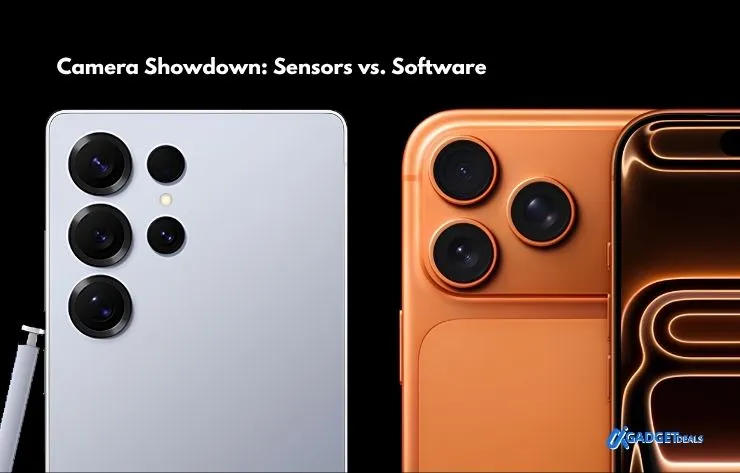
The Galaxy S26 Ultra brings a quad-camera setup headlined by a massive main sensor, paired with a dedicated periscope telephoto lens that delivers genuinely impressive zoom range. If you shoot a lot of distant subjects, concerts, wildlife, or sports from the stands, this is hard to beat.
The iPhone 18 takes a different approach. Apple is reportedly introducing a variable aperture on its main camera, letting it widen for low-light and shallow depth-of-field shots, then narrow back down for crisp, detailed daylight photography. It’s a meaningful upgrade for portrait and night photography specifically, even if the overall camera count and zoom range still favor the Galaxy.
Photo processing also reflects each company’s philosophy: Apple tends to favor more natural, true-to-life color science, while Samsung leans toward punchier, more vibrant output straight out of the camera app. Neither is objectively “better” it really comes down to personal taste.
Battery Life and Charging
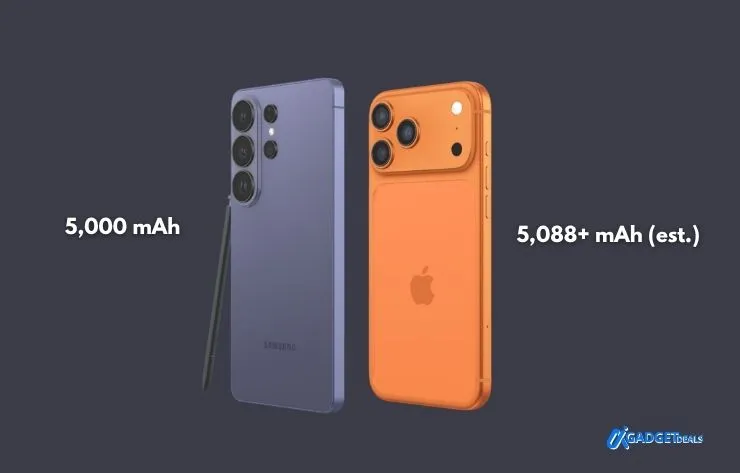
Battery capacity numbers can be misleading on their own, but here’s what’s worth knowing: Apple’s chip efficiency typically gives the iPhone an edge in real-world battery longevity, even when the raw mAh numbers look close between the two phones.
Where Samsung claws back ground is charging speed. The Galaxy S26 Ultra supports significantly faster wired charging than the iPhone, which matters a lot if you’re someone who tends to forget to charge overnight and needs a quick top-up before heading out the door.
| iPhone 18 (Pro Max) | Galaxy S26 Ultra | |
| Battery | 5,088+ mAh (est.) | 5,000 mAh |
| Wired charging | ~40W | 60W |
| Wireless charging | ~25W | 15W |
Software and Ecosystem: The Real Deciding Factor
Here’s the thing most spec-sheet comparisons miss: for most people, this decision isn’t really about specs at all. It’s about ecosystems.
If you already own a MacBook, an iPad, AirPods, or an Apple Watch, the iPhone 18 slots into that world seamlessly. Handoff, AirDrop, iMessage, and Apple Intelligence: these features are genuinely more useful the deeper you’re already invested in Apple’s ecosystem. Apple also tends to support its phones with software updates for longer, which matters if you like holding onto a device for four or five years.
The Galaxy S26 Ultra, meanwhile, is the better fit if you’re embedded in Google’s services, use Windows daily, or simply prefer the flexibility that Android offers, such as customizable home screens, default app choices, and file management that doesn’t fight you at every turn. Samsung also commits to several years of OS updates these days, closing a gap that used to heavily favor Apple.
Then there’s Galaxy AI versus Apple Intelligence — both are racing to bake generative AI features directly into the phone experience, from live translation to smart photo editing. Neither has a runaway lead here yet, and honestly, both are evolving fast enough that whatever we say today might shift within months.
Price: What You’re Actually Paying For
Pricing between these two flagships tends to land in similar territory at launch, though Samsung typically offers more aggressive trade-in deals and promotional pricing in the weeks following release. Apple, true to form, rarely discounts directly, but third-party retailers and carrier deals can close that gap quickly.
This is actually where keeping an eye on deals pays off. Prices on both phones tend to drop meaningfully within the first few months as newer models loom on the horizon, and bundling trade-ins with carrier promotions can shave hundreds off the sticker price. We track exactly this kind of movement on our website, so if you’re not in a rush, it’s worth waiting a beat before buying at full price.
So, Which One Should You Actually Buy?
Let’s bring it all together.
Choose the iPhone 18 if:
- You’re already invested in Apple’s ecosystem (Mac, iPad, Apple Watch)
- Performance efficiency and long-term software support matter to you
- You prefer natural, true-to-life photo processing
- You want the smoothest possible day-to-day experience without much tinkering
Choose the Galaxy S26 Ultra if:
- You want the S Pen and the productivity features it unlocks
- Camera versatility and zoom range are a priority
- Fast charging is a must-have for your lifestyle
- You like an OS that lets you customize nearly everything
Neither phone is a wrong choice; that’s honestly the most refreshing part of this comparison. A few years ago, picking the “wrong” flagship meant real compromises. Today, it mostly comes down to which ecosystem you want to live in and which features actually fit how you use your phone.
Final Thoughts
At the end of the day, the iPhone 18 vs. Galaxy S26 Ultra debate isn’t really about which phone is objectively “better”; it’s about which one fits your life better. Apple’s strength has always been cohesion and polish; Samsung’s has always been flexibility and feature density. This year, both companies are playing to those exact strengths.
Whichever side you land on, do yourself a favor and don’t pay full price on day one if you don’t have to. Deals move fast on both of these phones once the initial hype settles, and we’re keeping a close eye on pricing trends right here on AIGadgetDeals so you don’t have to. Check back before you buy; your wallet will thank you.