
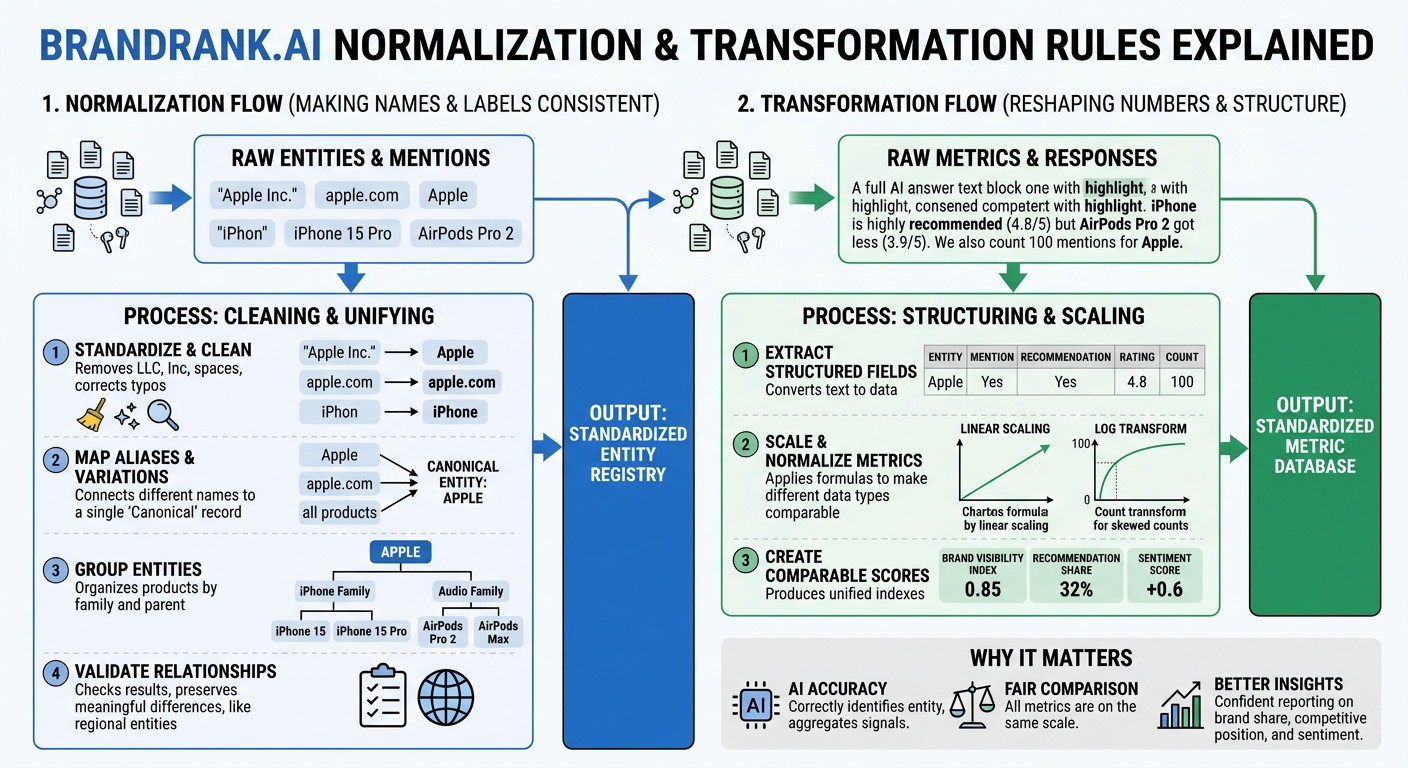
Quick Answer
BrandRank.AI normalization transformation rules refer to the process of making brand and product information consistent when measuring AI-generated recommendations. BrandRank.AI officially documents a four-step research process: Ask, Answer, Normalize, and Check. Its normalization step groups names by product family or parent company, but the company does not publish a separate technical rulebook under the exact phrase used in this keyword.
When businesses appear in AI-generated answers, their products, brands, and parent companies can be mentioned in different ways. Comparing those answers requires a consistent approach to identifying which names belong together.
BrandRank.AI addresses this issue through its documented research methodology. Understanding that process helps marketers, website owners, and technology professionals interpret AI recommendation data without confusing publicly documented features with assumptions about private algorithms.
What Are BrandRank.AI Normalization Transformation Rules?
Normalization and transformation are two related data-processing concepts.
Normalization makes information consistent so that different representations of the same entity can be recognized and compared. Transformation changes information into a different structure or format for a particular analytical purpose.
In the context of BrandRank.AI, these concepts relate to how brand and product names are organized when analyzing AI-generated recommendations.
For example, an AI answer might recommend a particular product, mention its product family, or identify the company that owns the brand. Without a consistent identification process, these references could be counted separately even when they belong to the same business.
Normalization helps establish the correct relationship between those records.
However, there is an important distinction: BrandRank.AI publicly documents a normalization step in its research methodology, but it does not publish a separate proprietary framework officially titled “Normalization Transformation Rules.”
The phrase is therefore best understood as a description of data standardization and grouping practices rather than the name of a confirmed standalone product feature.
Is BrandRank.AI Normalization an Official Feature?
BrandRank.AI is an AI brand intelligence platform that studies how AI answer engines recommend retailers, products, and brands.
Its official Research Hub explains how the company conducts AI Recommendation Share Index studies. The methodology includes four steps:
-
Ask: Submit the same customer questions to multiple AI answer engines under an identical testing protocol.
-
Answer: Record the brands, retailers, or products identified in the generated responses.
-
Normalize: Group related names by product family or parent company, depending on the measurement.
-
Check: Identify answers that are outdated, inaccurate, or unrelated to the original question.
The company provides practical examples of its normalization approach. Kindle and Ring can be grouped under Amazon, while Honda Civic can be associated with Honda.
These examples are particularly useful because they show that normalization is about understanding relationships between products and businesses, not simply correcting spelling.
You can review the methodology directly in the official BrandRank research documentation.
The distinction is important for anyone researching this keyword. The Normalize step is officially documented, but a separate technical specification containing a complete set of proprietary transformation rules has not been publicly established.
How Does the Normalization Process Work?
A useful way to understand normalization is to examine the different types of information that can appear in an AI-generated answer.
1. Brand Name Identification
A company can appear under several name variations.
For example:
-
BrandRank.AI
-
BrandRank AI
-
BRANDRANK.AI
-
BrandRank
A data-processing system may need to determine whether these references represent the same organization.
However, similar-looking names should not automatically be merged. Businesses with similar names can be entirely unrelated.
Reliable identification requires supporting information, such as official website details, company descriptions, and verified relationships.
2. Product and Parent Company Grouping
This is the part most clearly demonstrated by BrandRank.AI’s published methodology.
Consider a company that owns several product brands. AI engines might recommend individual products rather than mentioning the parent company directly.
A research system can organize these recommendations at different levels.
| Information identified | Possible grouping | Purpose |
|---|---|---|
| Kindle | Amazon | Parent company |
| Ring | Amazon | Parent company |
| Honda Civic | Honda | Parent brand |
| Individual product models | Product family | Product-level comparison |
This distinction matters because measuring product-level consensus is different from measuring recommendations for an entire company.
BrandRank.AI explains that it uses product-family grouping for consensus and parent-company or brand grouping for Recommendation Share.
3. Duplicate Record Identification
The same brand or product can appear multiple times across different answers.
For example, one AI engine may mention a company using its full name, while another uses a shortened version.
A normalization workflow should identify duplicate references without removing genuinely different recommendations.
This requires more than matching text. It may involve checking product relationships, company ownership, context, and the original answer.
4. Source and Information Consistency
AI visibility research also involves understanding where information comes from.
A brand might be mentioned in an answer alongside an outdated product name, an old company description, or an incorrect business relationship.
Checking these details helps prevent inaccurate information from being treated as a reliable recommendation.
BrandRank.AI specifically identifies outdated, inaccurate, and off-question answers as issues its research process checks.
What Is the Difference Between Normalization and Transformation?
Although these terms are often used together, they describe different operations.
Normalization focuses on consistency. It helps establish whether different representations refer to the same information.
Transformation focuses on changing the structure or representation of information so it can be processed, compared, or reported.
Consider a simple example.
A business might have its name stored in several formats across different datasets. Normalization identifies the verified name variations and connects them to one consistent business identity.
Transformation can then organize the information into fields suitable for reporting.
| Area | Normalization | Transformation |
|---|---|---|
| Main purpose | Establish consistency | Change data structure |
| Typical task | Match verified brand aliases | Create structured records |
| Example | Group related company names | Convert answers into report fields |
| Main benefit | Reduce inconsistent identification | Support analysis and reporting |
These concepts are not exclusive to AI marketing platforms. They are established data-management practices used in many technical applications.
The Unicode Consortium also documents text normalization standards. Its guidance explains how equivalent character representations can be converted into consistent forms for reliable comparison.
Its Unicode normalization documentation is useful for understanding text-level normalization, although Unicode normalization is different from matching companies or resolving product ownership.
Why Does Normalization Matter for AI Search Visibility?
AI answer engines do not always present information in the same format.
One system might recommend a parent company, another might identify a particular product, and a third might use a product-family name.
Without consistent grouping, analysts can misunderstand how often a company is recommended.
There are several reasons why this matters.
More Reliable Recommendation Measurements
If a company owns several recognized product brands, measuring each product independently may produce a different result from measuring the parent company.
Normalization makes the reporting level clear.
This is especially important when comparing businesses that have multiple products or brands.
Better Competitive Analysis
Businesses often want to understand how their visibility compares with competitors.
Consistent entity grouping helps prevent misleading comparisons caused by different naming conventions.
It also makes it easier to examine whether AI systems recommend individual products, product families, or parent companies.
Clearer AI Visibility Reports
A report is only useful when readers understand what its numbers represent.
For example, a recommendation measurement should explain whether it counts first-choice recommendations, mentions, or positions within a ranked list.
BrandRank.AI defines Recommendation Share using different scoring approaches depending on the type of index. Its Automotive Index uses ranked positions, while its Holiday Index measures the share of answers naming a brand first.
These distinctions matter when interpreting results.
Better Long-Term Comparisons
A consistent methodology also makes comparisons across different testing periods more meaningful.
If the same questions and grouping approach are used, analysts can better identify changes in recommendations over time.
However, results still need to be interpreted in the context of the specific AI engines, questions, and research dates.
How Can Businesses Apply Normalization Principles?
You do not need access to a proprietary AI analytics platform to apply basic normalization practices to your own brand information.
The following approach can help businesses organize their digital identity.
Step 1: Establish One Official Brand Identity
Choose the official business name and primary website.
Use these consistently across your website, business profiles, product information, and other relevant public records.
Step 2: Document Verified Name Variations
Record legitimate abbreviations, previous names, and commonly used variations.
Do not automatically connect every similar-looking name to your business.
Each relationship should have supporting evidence.
Step 3: Organize Products and Parent Brands
Create a clear record of your business structure.
Identify which products belong to which product families and which brands belong to the parent company.
This makes it easier to distinguish product-level and company-level information.
Step 4: Review Public Information
Check important business descriptions, product pages, and company profiles for outdated or contradictory details.
Pay attention to product names, ownership information, website addresses, and discontinued offerings.
Step 5: Keep Original Records
Never discard the original information simply because you have created a standardized version.
Keeping original records allows you to check whether a match or transformation was correct.
It also makes mistakes easier to identify and correct.
Common Mistakes When Understanding BrandRank.AI Normalization
Several misunderstandings can make this subject more confusing than it needs to be.
Treating the phrase as a confirmed proprietary algorithm: BrandRank.AI documents a Normalize step, but that does not establish a separately published technical rulebook under the keyword’s exact wording.
Confusing mentions with recommendations: A brand appearing in an AI answer does not necessarily mean the system recommended it as the first choice.
Combining unrelated companies: Similar business names are not sufficient evidence that two records belong to the same organization.
Ignoring product-level relationships: A product and its parent company represent different levels of brand information.
Assuming every AI platform behaves identically: Different answer engines can produce different recommendations, rankings, and descriptions.
The safest approach is to distinguish documented methodology from general data-processing principles.
What Should You Remember About BrandRank.AI Normalization?
BrandRank.AI normalization is best understood through the company’s publicly documented research methodology.
The Normalize step groups names according to product families or parent-company relationships. This helps researchers compare recommendations without treating every product or brand name as an unrelated entity.
Normalization and transformation are broader data-management concepts, and their practical applications extend beyond one platform.
For marketers and business owners, the main lesson is simple: accurate AI visibility analysis depends on consistent brand identification, clear product relationships, and careful interpretation of recommendation data.
If you are evaluating an AI visibility platform, always check its published methodology before assuming that a particular formula or technical rule is part of its proprietary system.
Frequently Asked Questions
What are BrandRank.AI normalization transformation rules?
The phrase describes data standardization and transformation practices used to organize brand information for AI visibility analysis. BrandRank.AI publicly documents a Normalize step in its research methodology, but a separate technical rulebook under this exact name has not been publicly verified.
Does BrandRank.AI officially use normalization?
Yes. Its official Research Hub describes normalization as the third step in its four-stage AI Recommendation Share Index methodology. The process groups names by product family for consensus and by parent company or brand for Recommendation Share.
What is the difference between normalization and transformation?
Normalization makes equivalent information consistent, while transformation changes information into a structure suitable for analysis or reporting. Both can be used together when processing brand and product data.
Why is brand normalization important for AI search?
Brand normalization helps analysts recognize related product and company references across AI-generated answers. It reduces inconsistent identification and makes recommendation measurements easier to interpret.
Can businesses use normalization without BrandRank.AI?
Yes. Businesses can maintain consistent brand names, document product relationships, verify company information, and organize their own data without using a specific platform. These practices can improve data quality, although they do not guarantee better AI search rankings or recommendations.